
-
By:
- elizabeth
- No comment
piano lessons for dummies pdf
Embarking on a musical journey with the piano is incredibly rewarding! Many resources, like Bill Hilton’s comprehensive PDF notes, offer a “piano lessons for dummies” approach.
These materials, alongside platforms such as PianoGenius, provide structured learning, making the initial stages accessible and enjoyable for everyone.
What is a “Piano Lessons for Dummies” Approach?
The “Piano Lessons for Dummies” approach centers around simplifying complex musical concepts into easily digestible steps, perfect for absolute beginners. It prioritizes practicality and immediate results, often utilizing readily available resources like PDF guides and online video tutorials.
Bill Hilton’s free piano course, accompanied by detailed PDF notes, exemplifies this method. His materials break down lessons into manageable segments, focusing on fundamental techniques and gradually building skills. This approach avoids overwhelming learners with theory upfront, instead encouraging learning through practical application.
Furthermore, platforms like PianoGenius offer extensive video lessons, complementing PDF materials and providing visual demonstrations. The core idea is to demystify piano playing, making it accessible and enjoyable for anyone, regardless of prior musical experience. It’s about building confidence and fostering a love for music through achievable milestones.
Why Learn Piano? Benefits and Motivation
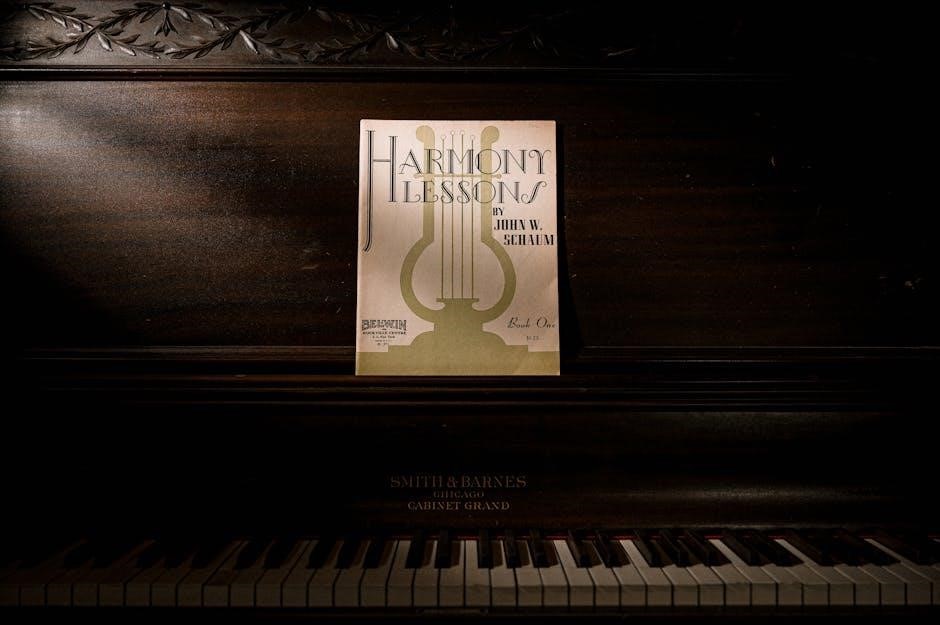
Learning piano offers a wealth of cognitive and emotional benefits. It enhances memory, improves coordination, and fosters creativity. The discipline required for practice translates to other areas of life, boosting focus and perseverance.
For beginners utilizing resources like “piano lessons for dummies” PDFs, the initial motivation often stems from a desire to play favorite songs or express themselves musically. Successfully navigating early lessons, aided by structured materials from sources like Bill Hilton, provides a significant confidence boost.
The accessibility of free online resources, including PianoGenius’s extensive video library, further fuels motivation. Seeing progress and mastering basic chords empowers learners to continue their musical journey. Ultimately, learning piano is a rewarding experience that unlocks a lifetime of musical enjoyment and personal growth.

Finding Free Piano Lesson Resources (PDFs & Online)
Numerous free resources exist for aspiring pianists! Bill Hilton’s PDF notes and PianoGenius’s video lessons provide excellent starting points for a “piano lessons for dummies” experience.
Bill Hilton’s Free Piano Course & PDF Notes
Bill Hilton offers a remarkably comprehensive and freely accessible piano course on YouTube, complemented by detailed PDF notes designed for beginner pianists seeking a “piano lessons for dummies” style learning experience. These resources are particularly valuable for those wanting a structured approach without financial commitment.
His course consists of 21 parts, with accompanying PDF notes available for lessons 1 through 20. Hilton conveniently compiles all these notes into a single, downloadable A4 PDF document, simplifying access and organization for learners. This consolidated format allows students to easily navigate the material and print it for offline study and annotation.
The PDF notes directly correspond to the video lessons, providing a valuable supplement for reinforcing concepts and practicing techniques. They are available for download alongside the YouTube series at Link/beginners, making it a complete and self-contained learning package.
PianoGenius: Accessing Extensive Video Lessons
PianoGenius presents a vast library of over 1,000 video piano lessons, offering a robust resource for beginners and those seeking to expand their skills. While not strictly a “piano lessons for dummies” PDF-based course, it provides an incredibly extensive alternative for visual learners. The platform’s strength lies in its sheer volume of content, covering a wide range of techniques and musical styles.
Access to these lessons is readily available online, allowing students to learn at their own pace and revisit concepts as needed. PianoGenius functions as a powerful supplement to PDF-based learning, offering demonstrations and practical applications of the theory presented in written materials.

The platform’s free training series, specifically “Free Piano Training 11,” highlights the accessibility of its resources. It’s a valuable tool for anyone looking for a dynamic and engaging way to learn the piano, complementing traditional learning methods.
Andersonstown Traditional & Contemporary Music School Resources
Andersonstown Traditional & Contemporary Music School offers resources that, while not directly a “piano lessons for dummies” PDF, contribute to a well-rounded musical education. Information available as of March 2015 (and likely updated since) suggests a commitment to providing accessible music instruction.
Though specific details regarding free PDF materials aren’t explicitly stated in the provided snippet, the school’s focus on both traditional and contemporary music implies a diverse curriculum. This could encompass beginner-friendly resources suitable for those starting their piano journey. Exploring their website directly would reveal current offerings.
The school’s existence highlights the broader landscape of piano learning options, supplementing free online resources like Bill Hilton’s PDFs and video platforms like PianoGenius. It represents a potential avenue for structured, in-person instruction alongside self-directed learning.

Understanding Basic Piano Concepts
Grasping fundamental concepts is key! Piano lessons for dummies PDFs often begin with keyboard layout, note identification, and music reading basics – staff, clefs, and rhythm.
Piano Keyboard Layout: Identifying Notes
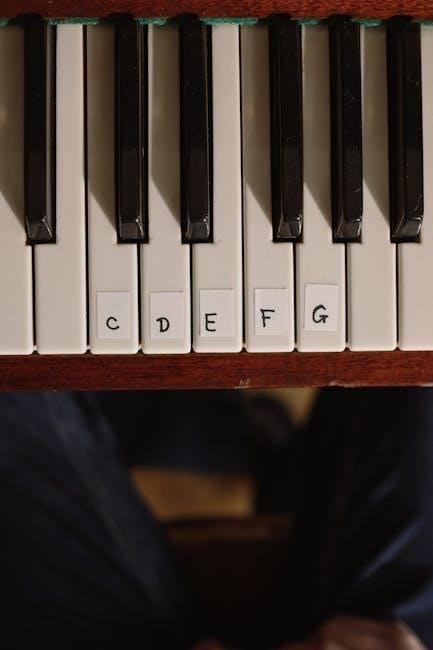
Understanding the piano keyboard is the first step! Many “piano lessons for dummies” PDFs begin by visually breaking down the repeating pattern of black and white keys.
The black keys are grouped in sets of two and three, serving as landmarks. White keys are named after the first seven letters of the alphabet: A, B, C, D, E, F, and G.
Locating ‘C’ is crucial – it’s always immediately to the left of a group of two black keys. From there, you can easily identify all other notes sequentially.
PDF resources often include diagrams and exercises to help you memorize these positions. Consistent practice identifying notes without looking will build muscle memory and accelerate your learning process. Mastering this foundational skill unlocks the ability to read music and play melodies!
Reading Music: Staff, Clefs, and Notes
Decoding musical notation is key to playing piano! “Piano lessons for dummies” PDFs typically introduce the musical staff – five horizontal lines and four spaces where notes are written.
At the beginning of the staff, you’ll find a clef symbol. The treble clef (often called the G clef) is used for higher-pitched notes, commonly played with the right hand. The bass clef (F clef) represents lower pitches, usually played with the left hand.
Notes are placed on the lines and spaces, each corresponding to a specific pitch. PDFs will illustrate how to associate each line and space with a note name (A, B, C, D, E, F, G).
Learning to quickly recognize note positions is vital. Practice reading simple melodies using the PDF’s exercises to build fluency and confidence.
Rhythm and Time Signatures Explained
Understanding rhythm is crucial for musicality! “Piano lessons for dummies” PDFs break down rhythm into manageable components. Notes aren’t just which key to press, but when to press it.
Time signatures, appearing at the start of a piece, tell you how many beats are in each measure (or bar). For example, 4/4 time means four beats per measure, with the quarter note receiving one beat. PDFs will visually demonstrate how to count these beats.
Different note values (whole, half, quarter, eighth) represent different durations. Learning to recognize and accurately play these values is essential.
Practice clapping rhythms and playing simple exercises from the PDF to internalize the feel of different time signatures and note durations. Consistent practice builds rhythmic accuracy.

Essential Techniques for Beginner Pianists
Mastering fundamental techniques is key! “Piano lessons for dummies” PDFs emphasize proper posture, hand position, and finger exercises for dexterity and efficient playing.
Proper Posture and Hand Position
Establishing correct posture and hand position is foundational for any aspiring pianist; Many “piano lessons for dummies” PDF resources, like those by Bill Hilton, stress the importance of sitting comfortably with a straight back, relaxed shoulders, and feet flat on the floor.
Your elbows should be slightly away from your body, allowing for free movement. The bench height is crucial – adjust it so your forearms are parallel to the keyboard. Regarding hand position, imagine holding a small ball; this creates a natural curve in your fingers.
Avoid tension! A relaxed hand allows for greater agility and prevents strain. Focus on keeping your wrists flexible and not too high or too low. Consistent attention to these details, as outlined in beginner PDFs, will build a solid technical base and prevent bad habits from forming.
Finger Exercises for Dexterity
Developing finger dexterity is paramount for piano playing, and numerous “piano lessons for dummies” PDFs incorporate targeted exercises. These often begin with simple scales and arpeggios, focusing on evenness and control. Bill Hilton’s materials, for example, likely include exercises to strengthen individual fingers and improve coordination.
A common starting point is the five-finger exercise – playing a sequence of notes within a five-note range, gradually increasing speed and accuracy. Another helpful exercise involves playing scales with different rhythms and articulations.
Remember to practice slowly and deliberately, focusing on proper technique. Consistent, short practice sessions are more effective than infrequent, lengthy ones. Online resources like PianoGenius can visually demonstrate these exercises, supplementing the PDF instructions and accelerating your progress.
Basic Chord Shapes (C, G, D, F)
Mastering fundamental chord shapes is crucial for any beginner pianist, and “piano lessons for dummies” PDFs prioritize these building blocks. The chords of C, G, D, and F are frequently the first taught, forming the basis for countless songs. Bill Hilton’s course notes likely detail the finger positioning for each chord, emphasizing accuracy and smooth transitions.
The C major chord (C-E-G) is often the starting point, followed by G major (G-B-D). Learning to switch between these chords fluidly is a key early goal. D major (D-F#-A) and F major (F-A-C) introduce slightly more complex fingerings.
Supplementing PDF diagrams with video tutorials from platforms like PianoGenius can greatly enhance understanding. Practice these chords in isolation, then begin incorporating them into simple progressions to build musicality.

Utilizing PDF Resources Effectively
PDF piano lessons, like those from Bill Hilton, are incredibly valuable! Download, print, and annotate them for personalized learning, supplementing with online video tutorials.
Navigating PDF Piano Lesson Materials
Successfully utilizing PDF piano lessons requires a strategic approach. Bill Hilton’s combined PDF, encompassing lessons 1-20 from his YouTube series, offers a convenient, all-in-one resource;
Begin by familiarizing yourself with the document’s structure; understand how each lesson builds upon the previous one. Utilize the PDF reader’s search function to quickly locate specific concepts or exercises.
Pay attention to any diagrams or musical notation included – these are crucial for understanding the material. Don’t hesitate to zoom in for clarity. Remember that these PDFs are designed to accompany the video lessons, so referencing both simultaneously will maximize your learning experience.
Consider using bookmarks within the PDF to mark important sections for easy access during practice.
Printing and Annotating PDF Lessons

For a more tactile learning experience, printing your PDF piano lessons is highly recommended. This allows for direct annotation, a powerful technique for reinforcing concepts.
Use a highlighter to mark key terms, important exercises, or areas where you struggle. Pencil annotations are ideal for writing reminders, fingerings, or personal notes directly onto the sheet music.
Consider printing in duplex (double-sided) to conserve paper. Ensure your printer settings are optimized for clear musical notation.
Binding the printed pages into a booklet can create a convenient and organized practice resource. Remember, actively engaging with the material through annotation significantly enhances retention and understanding, especially when using resources like Bill Hilton’s comprehensive PDF.
Supplementing PDFs with Online Video Tutorials
While PDF lessons provide structured content, combining them with online video tutorials dramatically enhances the learning process. Platforms like PianoGenius offer over 1,000 video lessons, providing visual and auditory reinforcement of concepts found in PDF materials.
Videos demonstrate proper technique, hand positioning, and musical interpretation – aspects difficult to grasp solely from written instructions. Use videos to clarify challenging sections within your PDF lessons, observing how an experienced pianist executes the piece.
Bill Hilton’s free piano course on YouTube perfectly complements his PDF notes, offering a comprehensive learning experience. Don’t hesitate to pause, rewind, and replay videos as needed to fully understand each concept.
This multi-faceted approach maximizes your learning potential.

Practice Strategies for Rapid Improvement
Consistent, focused practice is key! Set realistic goals, break down complex pieces, and utilize resources like Bill Hilton’s PDFs for effective learning.
Setting Realistic Practice Goals
Beginner pianists often stumble by setting overly ambitious goals. Instead of aiming for hours of flawless playing immediately, start small and build gradually. Consider utilizing the structured approach found in resources like Bill Hilton’s PDF notes, which accompany his 21-part free piano course.
These notes, available individually or combined into a single PDF, provide a clear progression. A realistic goal might be mastering one new chord shape per week, or successfully playing a simple melody from the PDF without errors.
Focus on consistent, short practice sessions – even 15-20 minutes daily is more effective than infrequent, lengthy ones. Celebrate small victories and acknowledge progress. Remember, the “piano lessons for dummies” philosophy emphasizes accessibility and achievable milestones, fostering a positive learning experience.
Consistent Practice Schedule
Establishing a consistent practice schedule is paramount for progress. Treat your piano practice like any other important appointment – block out specific times in your day and stick to them. Utilizing resources like Bill Hilton’s PDF notes, designed to accompany his free YouTube course, can help structure these sessions.
The PDF materials offer a clear pathway for beginners, allowing you to focus on specific lessons and exercises. A consistent schedule doesn’t require long hours; 30 minutes of focused practice, five days a week, is far more beneficial than sporadic, extended sessions.
Integrate practice into your routine – perhaps before breakfast, during a lunch break, or before dinner. Remember, consistency, aided by structured resources like these PDFs, is key to building muscle memory and developing your musical skills.
Breaking Down Complex Pieces
Facing a challenging piece? Don’t be intimidated! A core strategy for improvement involves breaking down complex musical passages into smaller, manageable sections. This approach, perfectly complemented by the structured lessons found in resources like Bill Hilton’s PDF notes, makes learning less daunting.
Begin by identifying difficult measures or phrases. Practice these sections slowly and repeatedly, focusing on accuracy before speed. Utilize the PDF’s accompanying exercises to reinforce specific techniques. Once mastered, gradually connect these smaller segments, building towards the complete piece.
Remember, patience is crucial. Consistent, focused practice on these isolated sections, guided by the PDF’s progressive structure, will ultimately lead to fluency and confidence. Don’t rush the process – build a solid foundation, one small step at a time.
Advanced Topics to Explore (Beyond the Basics)
Expanding your skills? Explore scales, arpeggios, and complex chord progressions, building upon the foundation established through beginner PDF resources and online tutorials.
Scales and Arpeggios
Delving into scales and arpeggios is crucial for developing technical proficiency and musical understanding. While initial “piano lessons for dummies” PDFs focus on basic chords and melodies, mastering scales unlocks a deeper connection to the instrument.
Scales provide the building blocks for improvisation and composition, while arpeggios enhance finger dexterity and coordination. Regularly practicing scales in all keys – starting with C major, then G, D, and so on – builds muscle memory and strengthens your understanding of key signatures.
Utilize online resources like PianoGenius alongside your PDF materials to visualize scale patterns and hear their application in musical contexts. Focus on smooth transitions and even timing. Arpeggios, broken chords played individually, further refine technique and add expressive possibilities to your playing;
More Complex Chord Progressions
Beyond basic C, G, D, and F chords, exploring more complex progressions expands your harmonic palette and musical expression. While “piano lessons for dummies” PDFs initially introduce simple chord structures, progressing to seventh chords, minor chords, and inversions adds depth and sophistication.
Common progressions like ii-V-I (Dmin7-G7-Cmaj7) are foundational in jazz and many other genres. Experiment with adding passing chords and substitutions to create unique harmonic colors. Resources like PianoGenius can demonstrate these progressions in action, showing how they function within songs.
Analyze the chord progressions of your favorite pieces and try to recreate them. Don’t be afraid to experiment and listen critically to the results. Understanding chord voicings and inversions will further enhance your ability to create rich and interesting harmonies.
Classical music is built upon established forms that provide structure and coherence. While “piano lessons for dummies” PDFs often focus on technique and basic theory, understanding these forms unlocks a deeper appreciation for the music.
Common forms include Sonata form (exposition, development, recapitulation), Theme and Variations, and Rondo. Recognizing these structures helps you anticipate musical developments and understand the composer’s intent. Bill Hilton’s course notes, complementing his YouTube series, can provide a starting point for analyzing these forms.
Begin by listening to examples of each form and identifying the different sections. Consider how the melody, harmony, and rhythm change within each section. Exploring these forms will broaden your musical understanding and enhance your performance skills.